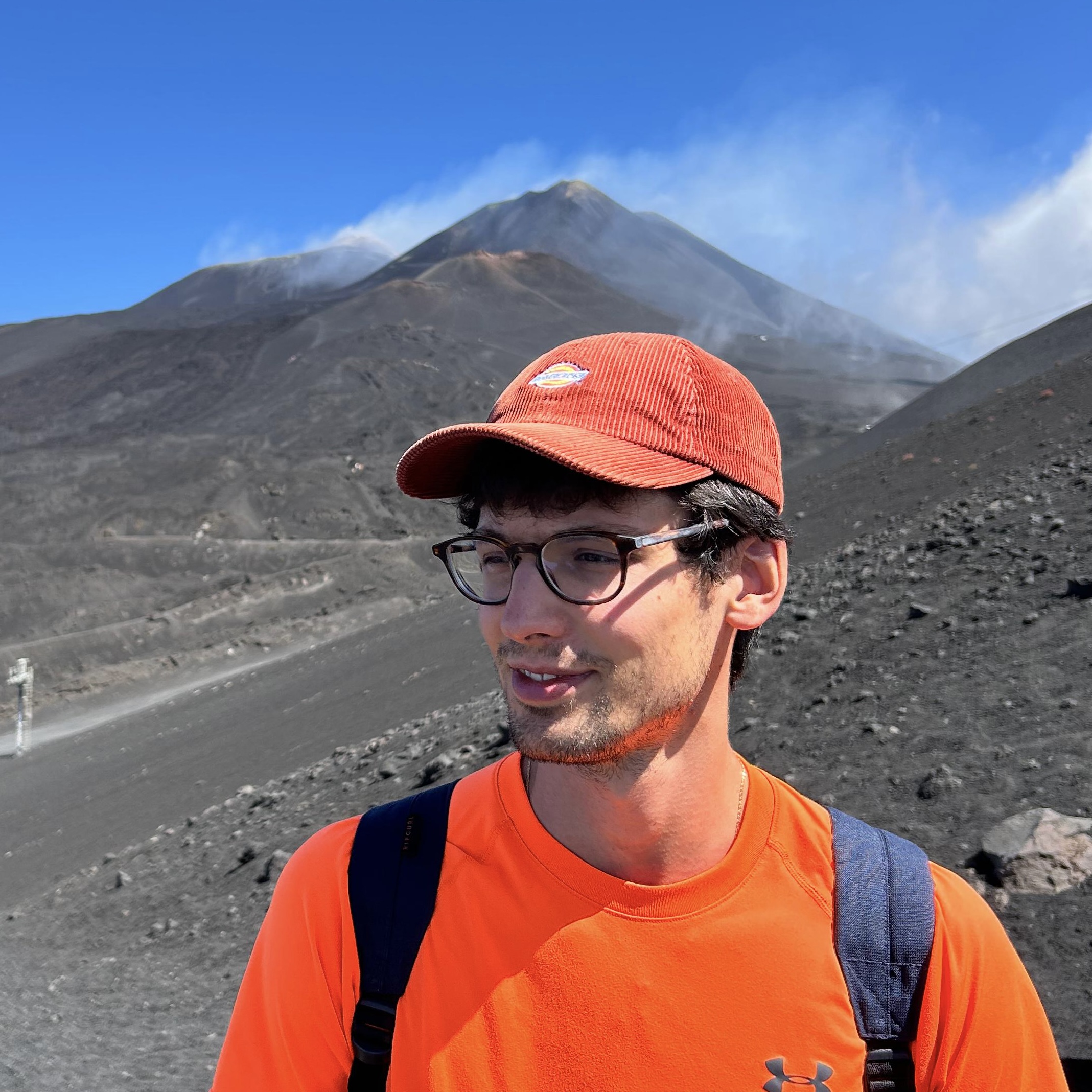
Samuele Ruffino

Generative Models • 3D Vision • Autonomous Driving

WIP: I’m a researcher working on generative models, computer vision, and autonomous driving, blending 3D/BEV perception, video generation, and multimodal world models.

Previously a Research Engineer (AI Foundation) at Torc Robotics, supervised by Prof. Felix Heide and Dr. Mario Bijelic, building layout-conditioned video diffusion models and evaluation pipelines.

M.Sc. in Electrical Engineering and Information Technology from ETH Zürich; B.Sc. in Electronics and Communications Engineering from Politecnico di Torino.

During my Master’s I completed internships at Siemens (video generation for autonomous driving), BMW Group (6DoF pose estimation for industrial applications), and IBM Research Zürich (neurosymbolic AI).

Recent Publications

View all →

ScenarioControl: Vision-Language Controllable Vectorized Latent Scenario Generation

Lili Gao*, Yanbo Xu*, William Koch*, Samuele Ruffino, Luke Rowe, Behdad Chalaki, Dmitriy Rivkin, Julian Ost, Roger Girgis, Mario Bijelic, Felix Heide

ECCV 2026

We introduce ScenarioControl, the first vision-language control mechanism for learned driving scenario generation. Given a text prompt or an input image, Scenario-Control synthesizes diverse, realistic 3D scenario…

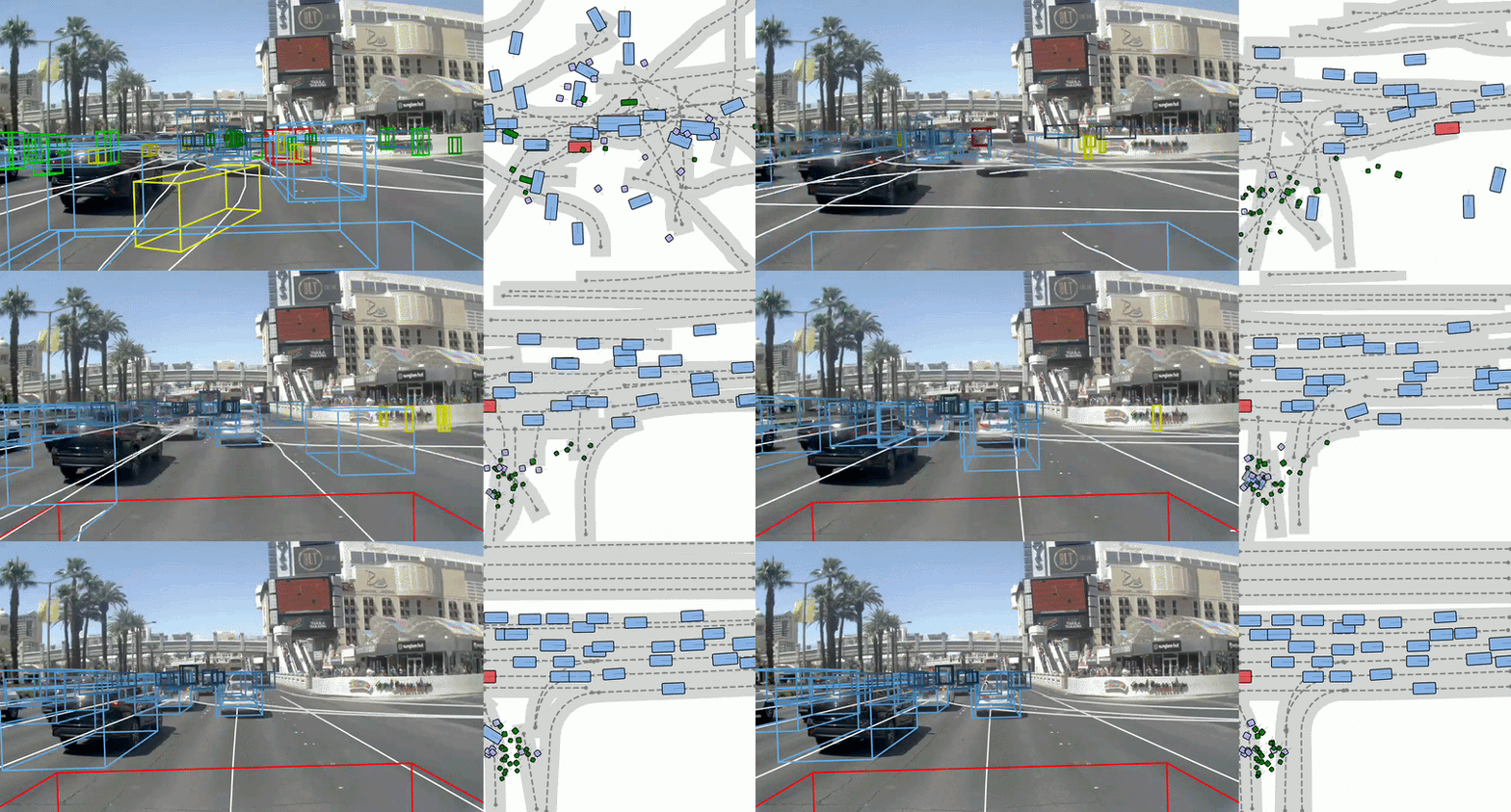
We introduce ScenarioControl, the first vision-language control mechanism for learned driving scenario generation. Given a text prompt or an input image, Scenario-Control synthesizes diverse, realistic 3D scenario rollouts - including map, 3D boxes of reactive actors over time, pedestrians, driving infrastructure, and ego camera observations. The method generates scenes in a vectorized latent space that represents road structure and dynamic agents jointly. To connect multimodal control with sparse vectorized scene elements, we propose a cross-global control mechanism that integrates crossattention with a lightweight global-context branch, enabling fine-grained control over road layout and traffic conditions while preserving realism. The method produces temporally consistent scenario rollouts from the perspectives different actors in the scene, supporting long-horizon continuation of driving scenarios. To facilitate training and evaluation, we release a dataset with text annotations aligned to vectorized map structures. Extensive experiments validate that the control adherence and fidelity of ScenarioControl compare favorable to all tested methods across all experiments.
Zero-shot Classification using Hyperdimensional Computing

Samuele Ruffino, Geethan Karunaratne, Michael Hersche, Luca Benini, Abu Sebastian, Abbas Rahimi

DATE 2024

Classification based on Zero-shot Learning (ZSL) is the ability of a model to classify inputs into novel classes on which the model has not previously seen any training examples. Providing an auxiliary descriptor in the…

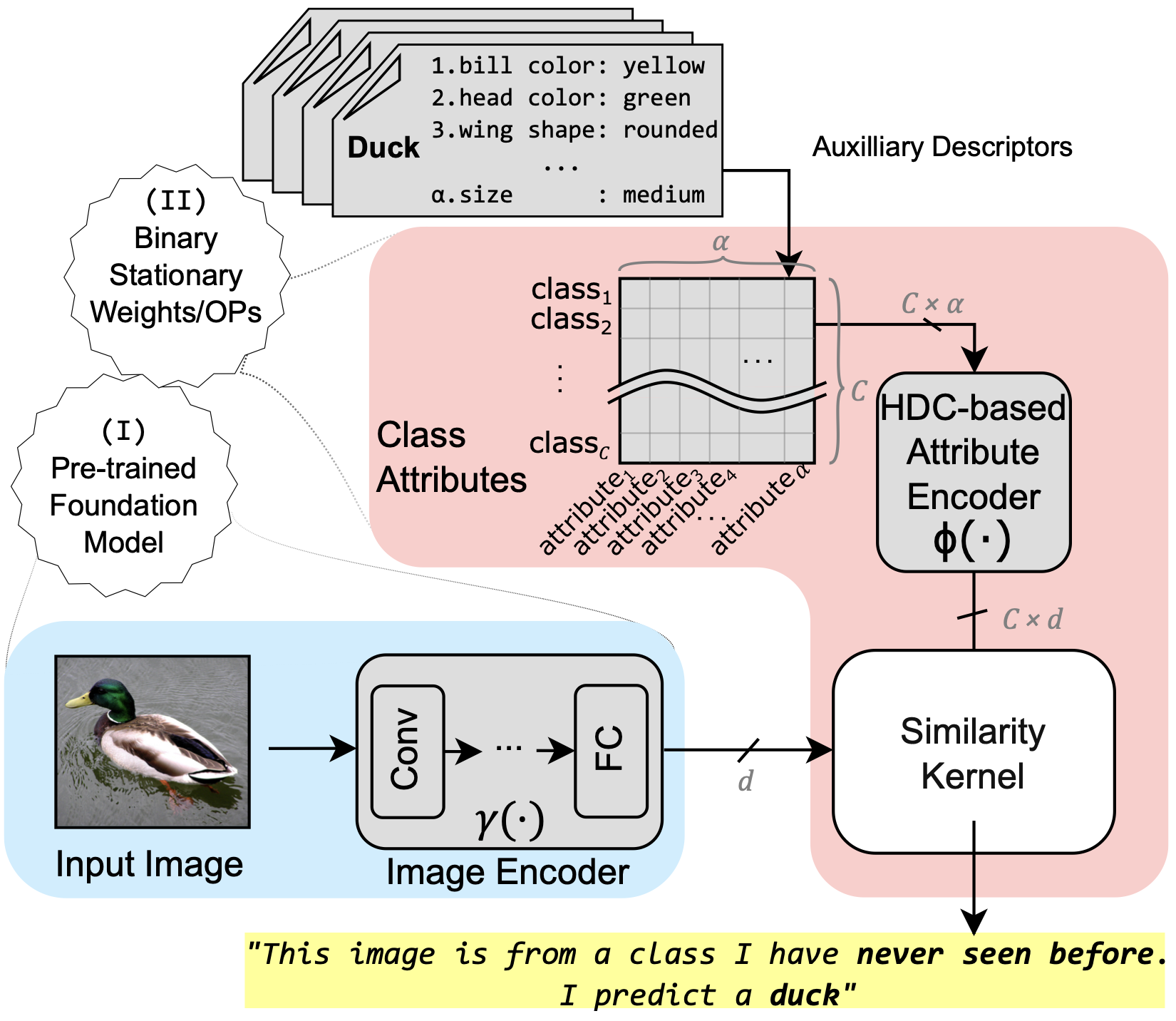
Classification based on Zero-shot Learning (ZSL) is the ability of a model to classify inputs into novel classes on which the model has not previously seen any training examples. Providing an auxiliary descriptor in the form of a set of attributes describing the new classes involved in the ZSL-based classification is one of the favored approaches to solving this challenging task. In this work, inspired by Hyperdimensional Computing (HDC), we propose the use of stationary binary codebooks of symbol-like distributed representations inside an attribute encoder to com- pactly represent a computationally simple end-to-end trainable model, which we name Hyperdimensional Computing Zero-shot Classifier (HDC-ZSC). It consists of a trainable image encoder, an attribute encoder based on HDC, and a similarity kernel. We show that HDC-ZSC can be used to first perform zero-shot attribute extraction tasks and, can later be repurposed for Zero-shot Clas- sification tasks with minimal architectural changes and minimal model retraining. HDC-ZSC achieves Pareto optimal results with a 63.8% top-1 classification accuracy on the CUB-200 dataset by having only 26.6 million trainable parameters. Compared to two other state-of-the-art non-generative approaches, HDC-ZSC achieves 4.3% and 9.9% better accuracy, while they require more than 1.85× and 1.72× parameters compared to HDC-ZSC, respectively.

Projects

View all →

Add items under content/projects/.

Latest Blog Posts

View all →

Add posts under content/posts/.